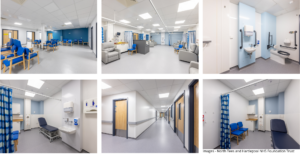
TGA are excited to announce the Emergency Assessment Unit refurbishment project at North Tees hospital has now been handed over!
Over the past few years, we’ve significantly expanded our healthcare portfolio, with numerous projects successfully completed and many more in the pipeline…
The completion of EAU North Tees marks a major milestone and was a fantastic project to be part of, with the new department being officially opened in October 2025 by Stacey Hunter, Chief Executive of University Hospitals Tees – attended by Emma Marshall and Will Powis who led the project for TGA.
This project involved the extension and refurbishment of the existing Emergency Assessment Unit to improve patient flow and the increase the departments capacity. The previous unit was deemed to be limited by the space and inefficient layout with the unit centred around a courtyard.
The new department dramatically increased the treatment and clinical capacity with the new department incorporating:
- Two new waiting areas
- Clinical assessments rooms
- Multi-chair treatment area
- Staff rooms
- Ancillary support areas
The existing courtyard was infilled to create an additional space and also allowed a new external plantroom to be formed on the roof of the infill building to accommodate new ventilation plant to serve the area. All of the services were designed to be HTM compliant and meet the clinical demands of the spaces.
TGA began work on the project in early 2024 as part of the design team with P+HS Architects, BGP Structural Engineers, Driver Project Services and Richmond Safety Services. The project was completed in August 2025 by Geoffrey Robinson and delivered by the NTH Solutions Design and Development Team.
One of the challenges of this particular project was to complete the works in a live hospital environment and to allow the department to remain functional throughout so as to maintain services to patients. This meant carefully phasing the works and carrying out enabling works to ensure no services were adversely affected.
While each healthcare project brings its own unique challenges and client-specific requirements, we’re proud to share a reflection of the key steps we typically follow to consistently deliver high-quality healthcare environments.
🛠️ The Design Process…
Clinical and Estates Team Engagement
On every project we try to engage as early as possible with the clinical team and the estates teams.
For this project the early stages of the project were centred around clinical engagement between the end users and the design team to ensure the proposed layouts and services reflected the clinical needs to maximise the efficiency of the unit. This early and ongoing engagement was critical to the success of the project.
TGA engaged with the estates team during surveys and review of early design proposals in order to ensure the design incorporated any site requirements, specific manufacturers and operational/ maintenance requirements. This minimises abortive works and ensures the M&E design.
Design Team Collaboration
Continual design team engagement is critical to ensure designs are aligned and coordinated throughout the programme. Attending regular DTMs is critical as well as additional ongoing communication between parties to ensure everyone is aware of any changes and specific requirements.
Clinical and Estates Sign off
At each stage of the design a review and sign off process is important; this is required for both the clinicians and the estates team to ensure every aspect of the design is agreed and reflects the requirements of the project.
🚧 Construction Process and Handover:
Engagement with Contractors
Once the design is completed and the contractor is appointed, we ensure that we have early engagement and review of the design. We always try to ensure we have a positive working relationship with the construction team which helps to ensure a smooth process on site. The main impact for our work was the vent needing to be adjusted slightly during this time, for which the contractor was extremely helpful.
On Site Presence and Support
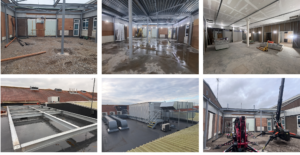
Phase 1 of the construction began in October 2024. Enabling works were completed to the services to allow the different phases to remain live throughout the works. The first stage of the construction process was the demolition of the existing office extension in the courtyard to allow the courtyard to be infilled with a new steelwork framed building, increasing the floor area of the department significantly.
TGA provided support to the client and the contractor throughout this process especially regarding the complexity of the phasing in relation to the services. Phase 1 was completed in May 2025.
Works to Phase 2 were then started, this included converting the existing 4 bed bays to the multi-chair treatment room and the creation of more clinical treatment rooms and waiting room. Phase 2 was completed in August 2025. Images below show the design process through both phases!
Handover
TGA attend site at the end of every project to ensure the final installation reflects the design. This was carried out for each Phase of the works on this project before they were handed over to the clinicians for use.
The above framework may vary slightly depending on the project, but it offers a clear view of the approach TGA takes to support adaptable, effective, and future-ready healthcare spaces.
Overall, this project culminated in the successful delivery of a high-quality healthcare facility that is poised to benefit numerous patients in the years to come!
A big well done to all involved! 👏