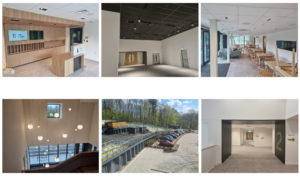
Construction works have now completed at The Light, the former Durham Light Infantry (DLI) Museum and Art Gallery, with gallery fit out currently underway ahead of a planned opening in summer 2026!
This £17m refurbishment and extension has significantly expanded the building’s facilities, doubling its floor area to support a permanent collection alongside flexible gallery accommodation for loan items and travelling exhibitions from national and international galleries. Set within the wooded landscape of Aykley Heads, the development responds carefully to its sensitive surroundings while delivering modern, adaptable spaces suitable for contemporary museum use, alongside new conference facilities, a destination restaurant, café spaces and accommodation for local artists.
TGA worked as part of a multidisciplinary design team for Durham County Council to deliver an integrated approach spanning building services engineering, building performance input and specialist lighting solutions aligned with the technical, conservation and operational requirements of the project.
🌱 Building Performance and Sustainability
TGA’s Building Performance input supported efficient operation and the project’s sustainability ambitions through application of the energy hierarchy, informing early decisions on orientation and layout to reduce energy demand, optimise solar gain and maximise daylight.
Heating and daylight analysis helped refine the design, while a CIBSE TM54 operational energy analysis was undertaken to assess expected in-use performance, to help minimise the performance gap between predicted and actual energy use and benchmark the building’s predicted operational energy against industry standards.
🔧 Mechanical Services
The mechanical services strategy has been developed to provide stable, controlled internal environments suitable for gallery and exhibition spaces, while maintaining efficiency and operational flexibility.
Heating and cooling are delivered via a Variable Refrigerant Flow (VRF) system, enabling simultaneous heating and cooling with heat recovery. Gallery and exhibition areas are served by air handling units incorporating integral DX coils, with downstream duct-mounted heating and cooling (trimming) coils and steam humidifiers. This arrangement enables precise control of supply air temperature and relative humidity in accordance with GIS environmental requirements for sensitive collections and loan items.
Back-of-house areas are served by electric heating and dedicated extract systems. All mechanical systems are integrated through the central Building Management System to support efficient, coordinated operation.
⚡Electrical Services
The electrical infrastructure has been designed to support resilience, adaptability and future exhibition requirements.
A dedicated on-site substation supplies a low-voltage system that is strategically distributed throughout the building to serve the various load centres. Dedicated server rooms with UPS battery back-ups provide robust infrastructure to support data and operational requirements across the site.
Each gallery space is served by its own dedicated distribution board, allowing exhibitions to be adapted or refitted without interruption to adjacent areas. Galleries are also provided with both overhead and underfloor low-voltage power outlets, offering a flexible solution capable of accommodating a wide range of exhibition layouts and bespoke installations.
A state-of-the-art composite security system has been implemented in line with Government Indemnity Scheme (GIS) requirements, supporting the safe display of valuable collections.
Electric vehicle charging points have been provided within the main car park adjacent to the principal access road. The car park is covered by CCTV and discreetly illuminated to ensure user safety while remaining sympathetic to the surrounding landscape.
A dedicated roof-mounted plant compound has been constructed to accommodate essential equipment in a clear, coordinated arrangement while limiting visual impact. A new photovoltaic system was also installed on the roof to reinforce the building’s green credentials.
💡A Coordinated Lighting Approach
Specialist lighting design plays a key role in shaping both the internal and external experience of the building.
Internally, a custom-designed lighting feature has been introduced within the new three-storey atrium, providing a focal point that visually connects the building’s levels while also supporting retail and shop lighting through a combination of decorative elements and adjustable spotlights.
Gallery spaces are equipped with highly adaptable, energy-efficient lighting systems, with colour rendering suitable for high-end exhibition environments. Track-mounted installations provide full positional flexibility, while individual wireless Bluetooth control allows each light source to be tuned to suit specific artefacts. This approach helps to minimise light spill and focus illumination exactly where it is required, supporting both presentation and conservation requirements. The lighting design to the gallery is on a par with and mimics the requirements at prestigious institutes such as the British Museum and National Portrait Gallery to ensure all touring exhibits are afforded the highest quality of illumination.
Externally, lighting has been carefully designed to respond to the building’s woodland setting. A subdued strategy incorporating columns and bollards supports safe access and wayfinding while remaining sensitive to the surrounding ecology and promoting inclusive use of the site during evening hours.
With construction now complete, focus has shifted to the internal fit-out of gallery spaces in preparation for the museum’s reopening in summer 2026.
We are pleased to have contributed building services and specialist lighting expertise to a project that brings together conservation requirements, operational flexibility and long-term performance within a sensitive heritage and landscape context.
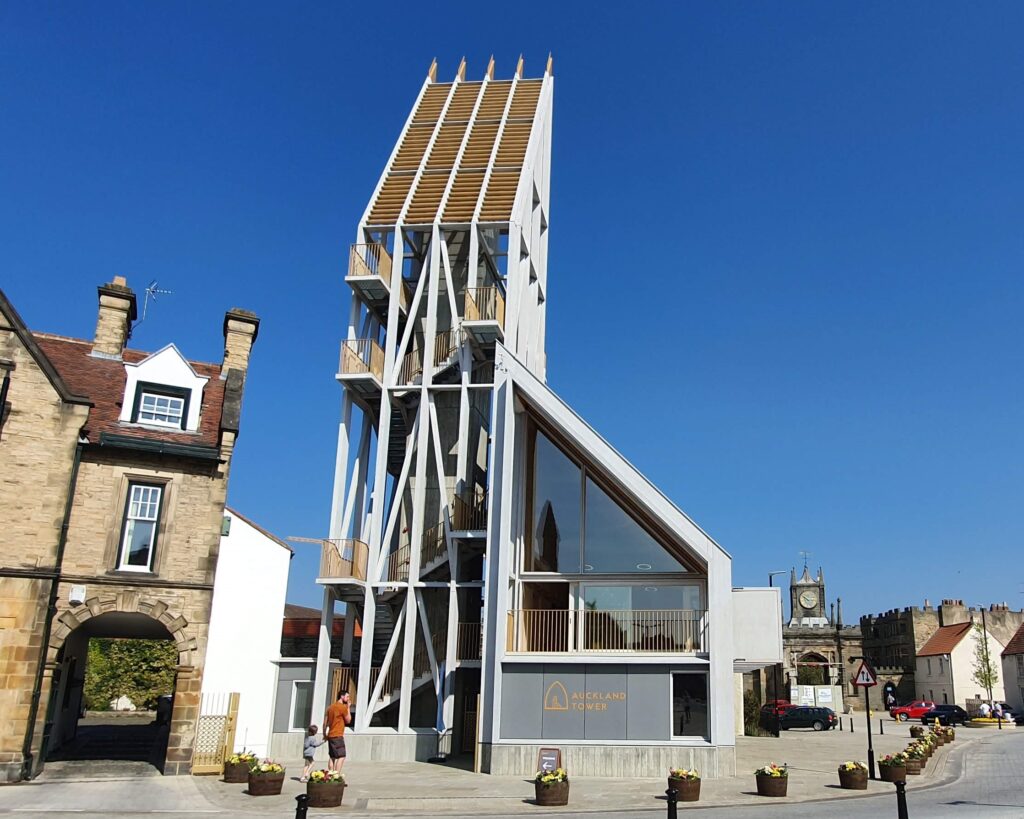
This project is also featured in the April edition of Living North East (page 98) as part of the ‘Destination Durham’ feature, alongside three other projects TGA has been involved in. It’s great to see a range of high-quality projects across Durham highlighted within one publication – Living North East.
You can read our full case study here: The Light – Former Durham Light Infantry Museum and Art Gallery.
The Light is also a finalist in the Constructing Excellence North East 2026 Awards – one of the region’s most prestigious built environment awards – in the Regeneration & Conservation category.
Well done to everyone involved in delivering this project. 👏